My Mural Gazer story, The Captain’s Glass, is a piece of period fiction, a genre I sometimes stumble into, and a place where I experience a sort of personality split, part of me wanting to live the life of other people in other times, another wanting to free myself from the constraints of historical accuracy.
The term ‘historical fiction’ is, after all, an oxymoron: history being a researched account of events that actually took place; fiction, an imagined sequence of events that never happened.
Tension between the terms is irreducible. The purpose of ‘real history’ is almost scientific, a documented analysis of past events that supports a thesis; the objective of historical fiction, a concoction of imagined events that convincingly reveal underlying truths, beliefs, personalities, ideas.
My purpose in The Captain’s Glass isn’t literal accuracy, all I need is enough believable detail to create the illusion that cabin boy Martin Cuthbert’s view of the world from the top mast of the Reindeer is something you – the reader or listener – are experiencing, and that the ingrained beliefs of his times and place are part of that experience.
To create that illusion I need just enough believable detail to convince you. I have to read historical documents, and imagine myself in the scenes and situations they describe – in this case, aloft in the crow’s next of a British warship, heading toward my present day home in Chemainus, BC.
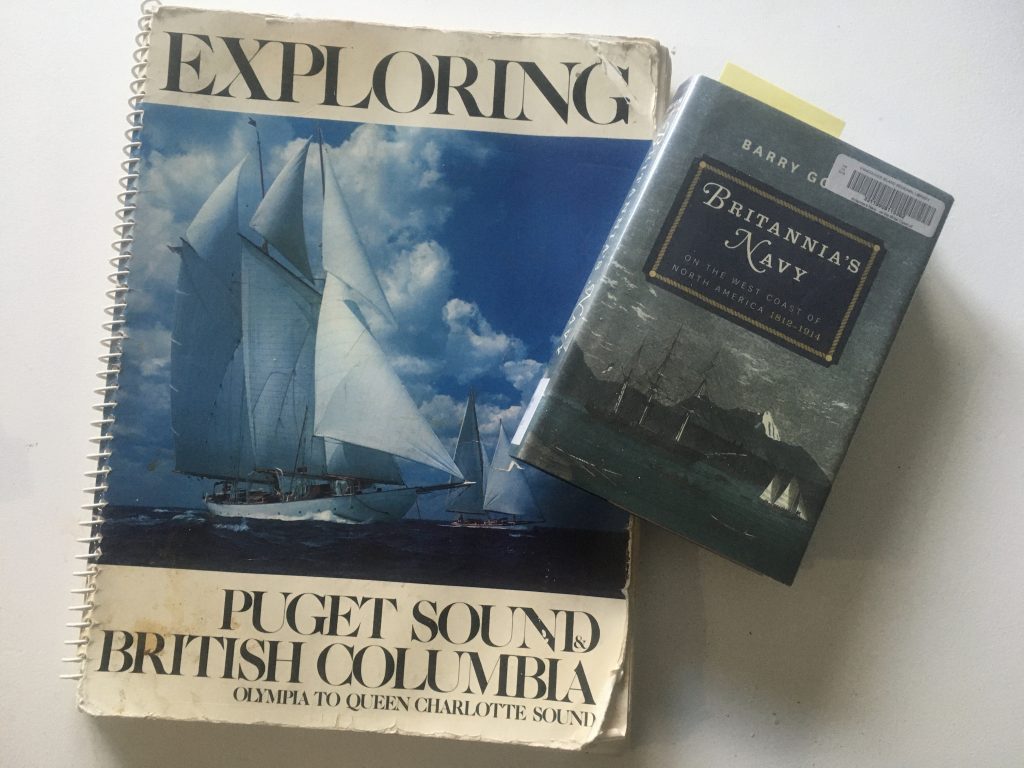
Two sources have given me a European perspective on this place in that time. A sailor friend loaned me an annotated chart book, Exploring Puget Sound & British Columbia by Stephen E. Hilson, published by Van Winkle Publishing Company in 1975; and a borrowed Vancouver Island Regional Library copy of Britannia’s Navy on the West Coast of North America – 1812 to 1914, by Barry Gough, Heritage House Publishing Company, 2016.
The main thing I want to portray in the context of those publications is the colonial mindset of the people aboard the Reindeer, and the difficulty anyone would have gainsaying the attitudes of fellow crew members – especially anyone in the lowest ranks, like a cabin boy.
History is not always something we can be proud of, and the atrocities of the colonial era, which will require generations to heal, are something I believe we all have to take either responsibility or blame for.
The starting place for me is an understanding of my ancestors’ failure to: appreciate the knowledge and culture of the people who had lived on this land for millennia before ships like the Reindeer rounded Cape Horne; and the unwavering rapaciousness and greed of an economic system that saw nothing of value in the land, unless it yielded a profit.
We own that history. The challenge now is to prove, through reconciliation and environmentalism, that our modern society is enlightened and determined enough to undo the damage wrought by our ancestors. The importance of Martin Cuthbert is his ‘secret admiration for a race of hunter-gatherers, who lived off the land and – to his mind – in harmony with it’, the fictional-fact that he ‘wondered what might be learned’ from aboriginal peoples.
His could have been the starting point of history between European colonists and indigenous peoples, but his mates did not share the cabin boy’s perspective, and justified the appropriation of First Peoples’ land through racist logic. They were men of their times – and in fairness, no worse than most humans of that era.
Many are thinking differently in the 21st Century. Increasingly people are coming to realize that the mark of a ‘great civilization’ will be its ability to build toward an inclusive future. That’s what the laborious process of Truth and Reconciliation in Canada is about.
Martin Cuthbert, the cabin boy, was a harbinger of that ethic. If we can make real his seminal belief, we will be the first civilization in history to have ever achieved the kind of harmony and prosperity it leads to.